
Bridging Mind, Technology, and Leadership with Tony Simon, Ph.D.
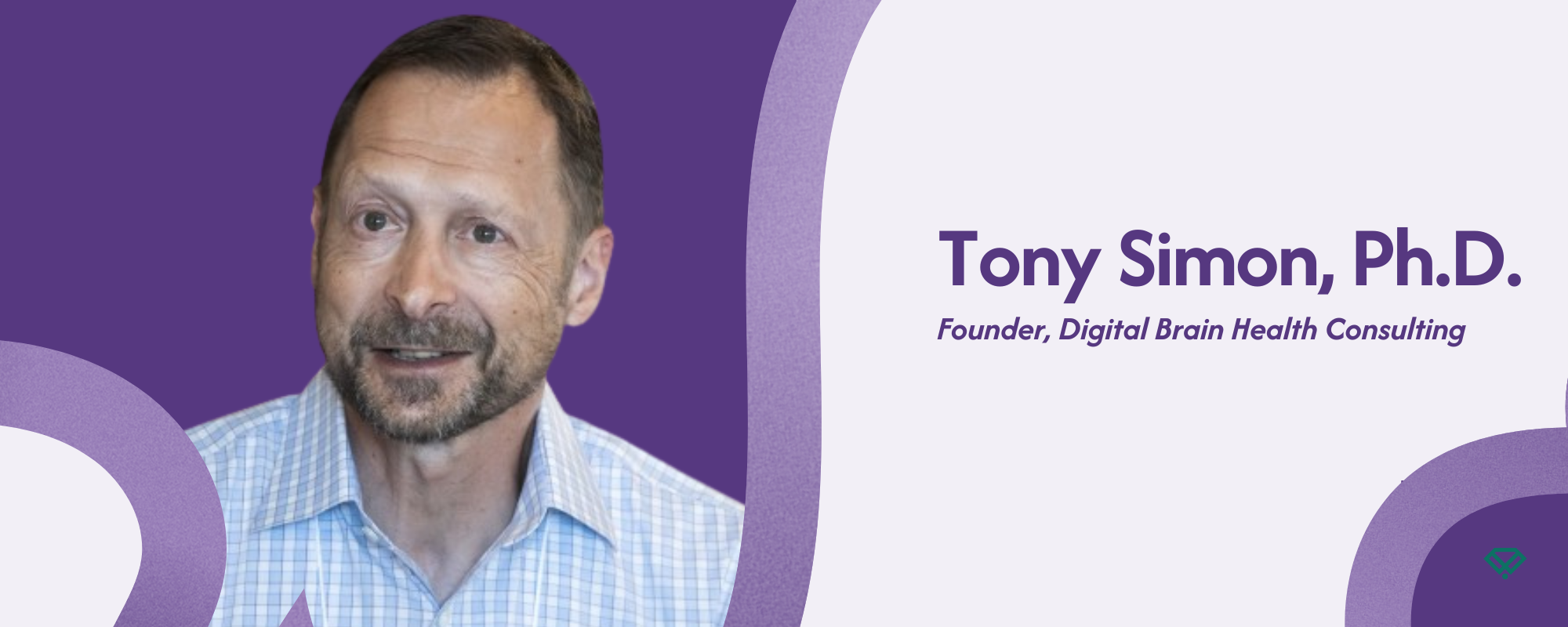
Tony Simon, Ph.D., has spent more than four decades pursuing a single, driving question: how do we understand the human mind well enough to help it function at its best? His career has unfolded across worlds not often bridged; from leading groundbreaking cognitive neuroscience research at the UC Davis MIND Institute, to founding an early-stage neurotherapeutics startup that raised nearly $1M in angel funding, to shaping the product and science strategies behind industry-defining digital therapeutics at Akili.
With more than 110 peer-reviewed publications, patented VR-based treatments, and deep experience guiding cross-functional teams through scientific, technical, and commercial complexity, Tony has become a sought-after voice in how we translate big ideas into solutions. He has built his work around the belief that technology, when grounded in rigorous science, can fundamentally reshape how we diagnose, treat, and maintain brain health.
Now entering the fractional leadership space, Tony brings a rare mix of academic depth, entrepreneurial grit, and product vision to early-stage companies. His ability to connect science with real-world applications, and to do so with clarity, curiosity, and mission-driven energy, positions him as a powerful partner for teams building the next generation of digital health innovation.
Q: For people meeting you for the first time, how would you describe the through-line of your career and what has motivated your work?
Tony: Since I was a kid, I’ve always been driven by one question: how does it work? Early on that curiosity focused on the human mind and brain. Over the last 40 years, I’ve explored that question across research, product development, education, and digital therapeutics. Whether it’s understanding typical development, helping someone recover from injury, or identifying impairments in cognitive functioning, my work has always centered on understanding human capability and how to move people from one level of function to the next.
Q: You’ve spent your career solving complex problems at the intersection of people, behavior, and technology. How has that shaped your approach to leadership and decision-making?
Tony: Technology has always been a massive enabler in my work. As tools evolved — from early computers to machine learning, to VR and mobile digital therapeutics — they opened new ways to test hypotheses, measure behavior, and translate science into usable solutions.
But when you move from science into business, decision-making becomes far more complex. The most sophisticated technology isn’t always the right tool if it’s too expensive, inaccessible, or impossible to commercialize. I’ve learned to ask: what is the simplest, most available, most cost-effective way to create impact? That mindset forces clarity and avoids chasing solutions that are scientifically elegant but practically unworkable.
I’ve also made unconventional career decisions along the way. They weren’t always popular, but they gave me a unique cross-disciplinary perspective that I now rely on heavily as a leader.
Q: You’re new to fractional leadership. What drew you to this model, and what kind of value do you hope to bring?
Tony: I’m passionate about fractional work because I believe it fills a critical gap — especially in digital therapeutics and health innovation. Startups need expertise in regulatory strategy, product, science, reimbursement, and operations. But they don’t have the resources to hire full-time senior leaders in every area, nor have enough work to justify it.
Fractional leadership solves that problem. Companies can bring in exactly the expertise they need for a defined scope, timeline, and cost, which makes planning and fundraising far more manageable. I’ve lived in the pain of trying to build a DTx (Digital Therapeutics) company without access to the right experts at the right time. Fractional leaders could have changed everything.
For this industry to grow, we need more flexible, experienced leaders who can parachute in, provide clarity, reduce risk, and accelerate outcomes without burdening early-stage teams.
Q: You’ve built and guided teams through major moments of change. What principles guide how you align people and move teams forward?
Tony: Everything starts with a mission. If people know why the work matters and who it serves, motivation takes care of itself. My role then becomes providing guidance and creating a culture where every voice is valued.
I also believe strongly in cross-functional collaboration. None of the problems I’ve worked on can be solved by a single discipline. You need scientists, designers, engineers, clinicians, product teams — all working together from the very beginning. My job is often to “lead from the side,” making space for expertise across the team.
And perhaps most importantly: everyone’s voice matters. Some of the best ideas I’ve seen have come from interns or junior team members who looked at a problem with fresh eyes.
Q: Innovation is often ambiguous and undefined. How do you help teams create clarity on the path forward?
Tony: If you’re doing something truly new, there is no playbook. You have to be willing to develop hypotheses, test ideas, fail fast, and reset without seeing that as failure. Mission-driven teams embrace that experimentation because they understand the stakes and the purpose behind the work.
I encourage teams to ask questions constantly, challenge assumptions, and be willing to rebuild something if it isn’t working. When people feel safe doing that, innovation accelerates rather than stalls.
Q: What qualities define truly innovative teams?
Tony: Mission-driven culture is essential — it creates alignment and resilience. But equally important is humility and willingness to collaborate across domains.
One of the biggest risks in innovation happens when someone assumes they know more than everyone else in the room. Great teams understand that expertise is distributed. They also understand that science-driven products require atypical workflows. Scientists must be involved from the beginning, not brought in at the end to validate or fix something. When teams embrace that, the whole becomes greater than the sum of its parts.
Q: You’ve advised founders, built products, and scaled teams. What lessons do you most often share with leaders following a similar path?
Tony: Two themes come up constantly.
First: know what you don’t know. As Søren Kierkegaard observed, true understanding begins with recognizing the limits of your own knowledge. Your expertise is essential, but so is everyone else’s. You can only succeed if you understand the constraints, workflows, and perspectives of the people you depend on.
Second: life is lived forward but understood backward. Founders are always navigating uncertainty without the benefit of hindsight. Fractional leaders have that hindsight — we’ve traveled those paths before, know the pitfalls, and can help teams avoid mistakes they don’t yet know to look for.
I also remind founders that scientific data is not the same as regulatory data, reimbursement data, or investor data. What you measure must match your business strategy, not just your hypothesis.
Q: Looking ahead, what shifts or trends do you think will shape the next generation of digital health and fractional work?
Tony: AI is unavoidable — powerful, risky, and transformative. But the bigger opportunity is shifting from our medical system’s current to one rooted in health and prevention.
We now wear, carry and use multiple devices generating continuous streams of behavioral and physiological data. With the right scientific and ethical frameworks, we can identify subtle changes in functioning decades before clinical symptoms appear. This has profound implications for early intervention in cognitive and mental health.
Digital tools can help keep people on healthier trajectories longer, reduce healthcare costs, and intervene far earlier than traditional models allow.
Q: As you step into fractional roles, what types of strategic challenges excite you most?
Tony: I’m most energized by opportunities to rethink neurobehavioral and mental health. Drugs are effective for many organs in the body, but the brain is different. It learns, adapts, and changes based on experience. Digital approaches can harness that plasticity in a way traditional medicines cannot.
The science, technology, and measurement capabilities are already here. The challenge is building business models that make them commercially viable. Helping companies navigate that strategic landscape is where I believe fractional leaders can create enormous value.
Q: What advice would you offer to others who are new to fractional work?
Tony: Be honest about your capacity and where you can provide the most value. Switching between companies, contexts, and problem sets has real cognitive cost. Choose engagements close to your expertise so you can deliver efficiently and effectively.
Transparency is everything — especially around scope, budget, and expectations. I often recommend defining clear quarterly commitments and reviewing them with the company. Sometimes you’ll stay on; sometimes they’ll no longer need you; sometimes you’ll feel you’ve given all you can. Clarity benefits everyone.
Q: You’ve also been in the founder seat. How does that perspective shape how you support companies today?
Tony: Founders are juggling too few resources, too little time, and too much pressure. They can’t afford mistakes — but don’t yet know what mistakes look like. Fractional leaders can change their trajectory by providing exactly the right guidance at exactly the right moment.
I also distinguish between consulting and fractional work. Consulting is advisory and often disconnected from operations. Fractional work means being embedded, building, leading, and owning outcomes. It gives companies predictability, budget clarity, and operational lift — things early-stage teams desperately need.