
The Fractional Work Trends Defining the New Year
How companies are rethinking leadership, talent, and growth in 2026
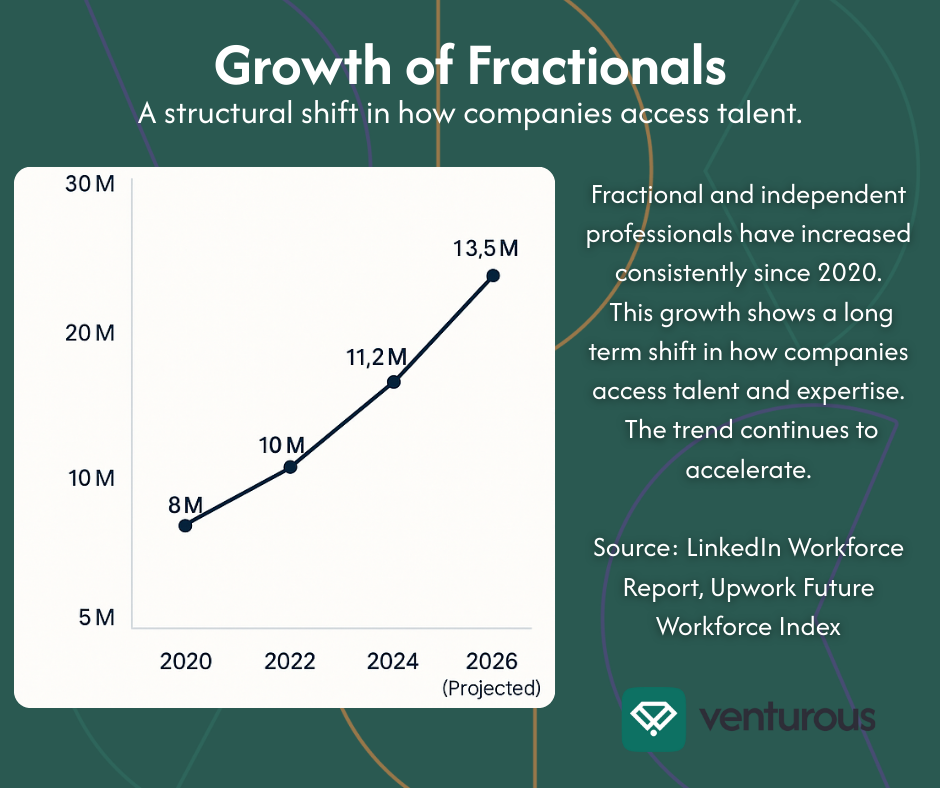
The way high-growth companies access talent has fundamentally changed. The old model of long searches, expensive full-time hires, and leaders stretched too thin no longer aligns with the pace most teams are trying to move at. As budgets tighten and priorities shift, founders want outcomes faster. They want leaders who can step in with clarity, focus, and the ability to deliver without months of ramp-up.
This is exactly why fractional work has accelerated. Across industries, more teams are choosing flexible, experienced operators who can solve specific problems at the exact moment help is needed.
Below are the key trends shaping fractional work in the year ahead and why this shift is creating one of the biggest talent opportunities founders and seasoned operators have seen in years.
1. Fractional Work Is No Longer a Backup Plan. It is Often the First Choice.
Recent research from LinkedIn and Upwork shows that fractional and independent professionals serving businesses grew 14 percent year over year and now represent more than 11 million workers. Companies are not waiting to hire full-time. They are filling leadership gaps fractionally as their default path.
The reason is simple. Speed matters. A fractional leader can start contributing in days. Full-time searches now take months and often stall growth during critical windows. Founders increasingly see fractional work as the most efficient way to access senior talent without slowing momentum.
2. The Rise of Portfolio Careers
Professionals are no longer defining themselves by a single title or employer. Instead, they are building portfolio careers that mix fractional roles, advisory work, consulting, and project-based engagements. This shift is especially visible at the executive and senior operator level. Leaders are opting out of traditional full-time roles in favor of greater control, variety, and impact.
Fractional work gives them the autonomy to apply their expertise across multiple companies while avoiding the bureaucracy and burnout that often come with full-time executive roles.
3. Companies Want Expertise, Not Headcount
Budgets have tightened across early-stage and growth-stage companies. Teams are under pressure to stretch every dollar while still delivering results.
Fractional leadership offers a solution. Companies can access proven operators at a fraction of the cost, paying only for what they need. More importantly, they get someone who knows how to execute. Someone who can build systems, improve performance, unlock revenue, or prepare the company for the next stage of scale.
This shift toward expertise over headcount is reshaping how founders think about talent altogether.
4. Remote Work Has Removed Geographic Barriers
The normalization of remote and hybrid work has unlocked a global market for fractional talent. Companies no longer limit their search to local candidates. They can hire fractional leaders from anywhere, which significantly expands access to high-caliber operators.
Fractional work was built to thrive in this environment. Clear scopes, focused deliverables, and outcome-based engagements work seamlessly across time zones and locations.
5. Specialization Is Becoming a Competitive Advantage
The companies adopting fractional talent most effectively are not looking for generalists. They want specialists who have solved their exact problem before.
A fractional Chief Financial Officer who has taken companies through Series A to Series C
A fractional Chief Marketing Officer who can build a demand engine and validate messaging in weeks
A fractional Chief Operations Officer who can build operational systems that support scale
This growing demand for niche expertise is shaping how fractional leaders position themselves and how companies evaluate talent.
Why This Matters for 2026 and How Venturous Fits In
Fractional work is no longer a temporary solution. It reflects a structural shift in how companies access talent and how leaders want to work. Founders want to move faster. Experienced operators want flexibility and meaningful impact. Investors want capital-efficient growth. All signs point to fractional talent becoming central to how companies scale.
This is where Venturous delivers value. Companies come to us when they need momentum and want leaders who can step in with clarity and execute quickly. The Venturous platform connects companies with vetted, US-based fractional executives across operations, finance, marketing, sales, and clinical leadership, among other areas. These are operators who have scaled organizations through inflection points and know how to deliver results under pressure.
For fractional leaders, Venturous provides a curated community, aligned opportunities, and a network built around knowledge sharing and impact. The companies that win in 2026 will build smarter and hire faster. Fractional work makes that possible. Venturous makes it accessible.
If your team is navigating a growth challenge or preparing for a shift, we can help you find the right leader to solve it.
Sources
LinkedIn, Why Fractional Work Will Explode in 2025—and How Executives Can Pivot Now https://www.linkedin.com/pulse/why-fractional-work-explode-2025and-how-executives-can-j-t-o-donnell-fwf5e/
Upwork, The Future Workforce Index: Evolving Talent Trends in 2025 and Beyond
https://www.upwork.com/research/future-workforce-index-2025
Independent Economy Council, The Rise of the Independent Workforce: Key Insights from the 2025 State of Independence Report
https://recruitingheadlines.com/the-rise-of-the-independent-workforce-key-insights-from-the-2025-state-of-independence-report/
Forbes, The Rise Of Fractional Leadership: A Lasting Shift In The Business Landscape
https://www.forbes.com/councils/forbesfinancecouncil/2025/02/20/the-rise-of-fractional-leadership-a-lasting-shift-in-the-business-landscape/
Fractinus, Research and Industry Commentary
https://fractionus.com/blog